
Overview
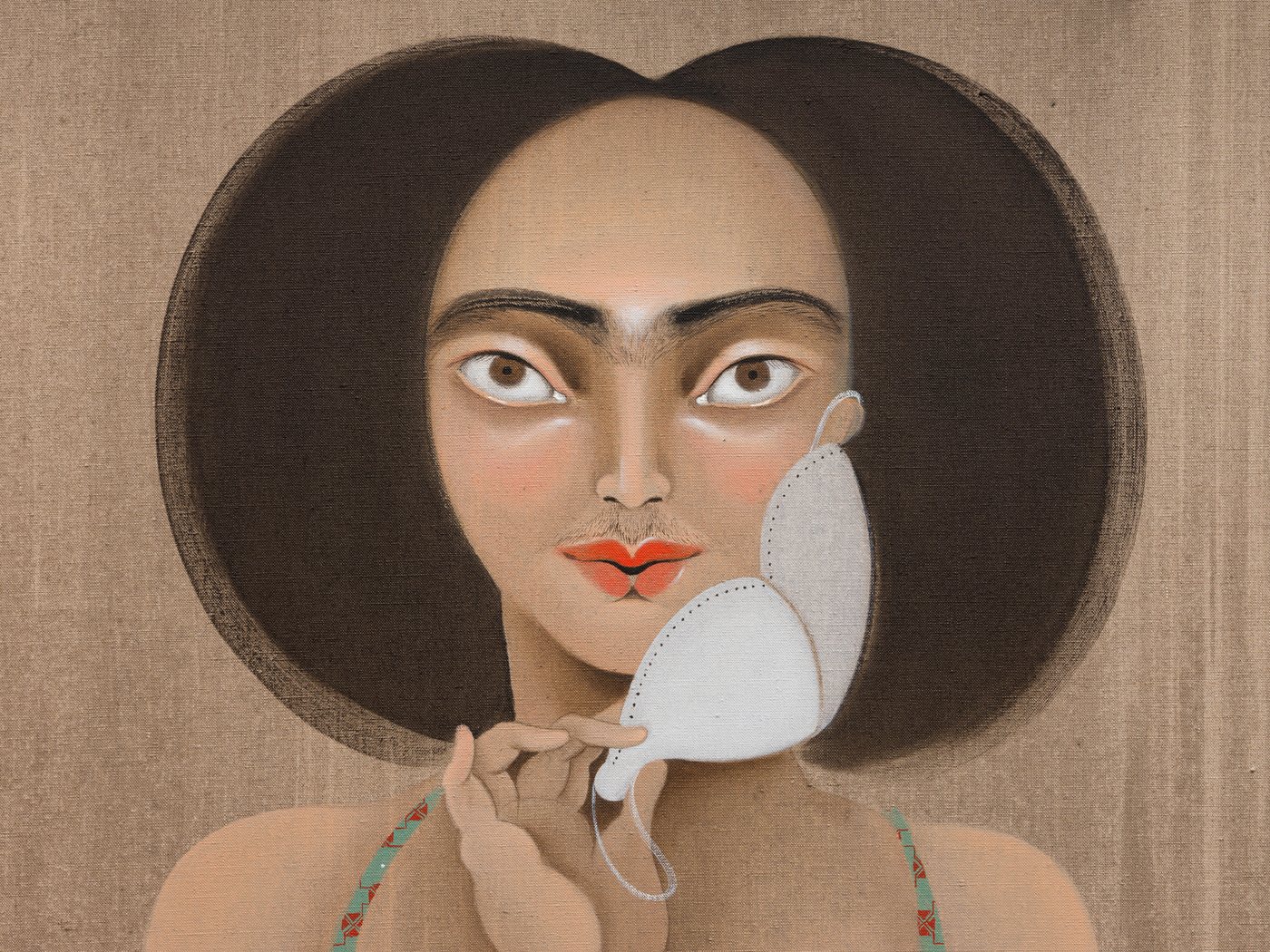
Pilar Corrias is pleased to present What cannot be said will be wept, an exhibition of new paintings by Hayv Kahraman.
The exhibition draws on Kahraman’s personal history as a Kurdish-Iraqi refugee and the loss of her home in the 2025 Los Angeles wildfires to consider the effects of systems that separate people from land, ancestry, ecology and embodied forms of knowledge. The artist's text, written to accompany the exhibition, is included in full below:
One of the deepest spells modernity has cast upon me is that of separation. Yes, I was extracted from my land through systemic violence, occupation and domination, this is one form of rupture. But there is another, more insidious severing I am only now beginning to name: a disconnection from my environment, from the natural world, from the human and more-than-human and from a kind of knowing behind knowing.
Modernity and coloniality has imposed the illusion that I am an isolated being, that the earth is not on my side. It has thinned my capacity for wonder, eroded my ability to dream within both the known and unknown worlds. It has distanced me from my indigenous ontologies that understand existence as entangled, relational and inseparable. In its wake, it has inscribed a betrayal into my body, carried consciously or not, shaping how I meet the ecologies around me, how I trust, how I relate. These works enact a remembering with the natural world, where entangled relationality is slowly taking shape.
In a burning world, I turn to water: to seas, to rivers, to tears. I forage for gestures, for rituals, for ways of being in ceremony with my ecology. Painting becomes a site of devotion, a practice through which relationality is cultivated and deepened and where grief is allowed access and is given form. The materiality of marbling, submerging the canvas in water, feels ceremonial and becomes a place where spirit might surface. A slow healing, enacted through immersion.
What I seek in these paintings is not resolution, but a kind of preparation, yielding me to sit with the undeterminable, to inhabit impermanence and to welcome an ancestral knowing that stretches across generations. A knowing that it is precisely our connection to the terrestrial and the celestial that holds us. As the logic of separability begins to dissolve, there is a surrender that happens. Not collapse, but a yielding. The kind spoken of in Sufi traditions, where a drop of water must cast itself into the vast ocean to lose its singularity. Or like the rain drop that moves through spiral-like deaths and rebirths across time, dissolving into a lake, being consumed and excreted by a deer, evaporating into the clouds and falling back again, altered. Each drop carries within it a tidal current of intergenerational and interspecies relation.
Strands, beads, salt tears, drops, oceans, these are movements across a cosmic web that exceeds linear time. The tear beads become interconnected strands in the divine fabric of existence. They remind us that we must grieve before we heal. Leaning into the sorrows of this era, imperial domination and systemic violence, climate chaos, ecological destruction, extinctions and environmental unraveling, awakens a profound realisation that our personal heartbreak is actually the planet's grief felt within us.
Perhaps we will arrive at a kind of sensing that extends beyond the material world slipping into something deeper. A place where tension and uncertainty are part of life and separability is only an illusion. The horizons in the paintings hold this paradox. They are sites of edges where opposites meet without resolving. They open toward an expansiveness that gestures to deep time, to ecological awareness, to remembering, and to the realisation that the earth never pushed us away.
– Hayv Kahraman
Pilar Corrias is pleased to present What cannot be said will be wept, an exhibition of new paintings by Hayv Kahraman.
The exhibition draws on Kahraman’s personal history as a Kurdish-Iraqi refugee and the loss of her home in the 2025 Los Angeles wildfires to consider the effects of systems that separate people from land, ancestry, ecology and embodied forms of knowledge. The artist's text, written to accompany the exhibition, is included in full below:
One of the deepest spells modernity has cast upon me is that of separation. Yes, I was extracted from my land through systemic violence, occupation and domination, this is one form of rupture. But there is another, more insidious severing I am only now beginning to name: a disconnection from my environment, from the natural world, from the human and more-than-human and from a kind of knowing behind knowing.
Modernity and coloniality has imposed the illusion that I am an isolated being, that the earth is not on my side. It has thinned my capacity for wonder, eroded my ability to dream within both the known and unknown worlds. It has distanced me from my indigenous ontologies that understand existence as entangled, relational and inseparable. In its wake, it has inscribed a betrayal into my body, carried consciously or not, shaping how I meet the ecologies around me, how I trust, how I relate. These works enact a remembering with the natural world, where entangled relationality is slowly taking shape.
In a burning world, I turn to water: to seas, to rivers, to tears. I forage for gestures, for rituals, for ways of being in ceremony with my ecology. Painting becomes a site of devotion, a practice through which relationality is cultivated and deepened and where grief is allowed access and is given form. The materiality of marbling, submerging the canvas in water, feels ceremonial and becomes a place where spirit might surface. A slow healing, enacted through immersion.
What I seek in these paintings is not resolution, but a kind of preparation, yielding me to sit with the undeterminable, to inhabit impermanence and to welcome an ancestral knowing that stretches across generations. A knowing that it is precisely our connection to the terrestrial and the celestial that holds us. As the logic of separability begins to dissolve, there is a surrender that happens. Not collapse, but a yielding. The kind spoken of in Sufi traditions, where a drop of water must cast itself into the vast ocean to lose its singularity. Or like the rain drop that moves through spiral-like deaths and rebirths across time, dissolving into a lake, being consumed and excreted by a deer, evaporating into the clouds and falling back again, altered. Each drop carries within it a tidal current of intergenerational and interspecies relation.
Strands, beads, salt tears, drops, oceans, these are movements across a cosmic web that exceeds linear time. The tear beads become interconnected strands in the divine fabric of existence. They remind us that we must grieve before we heal. Leaning into the sorrows of this era, imperial domination and systemic violence, climate chaos, ecological destruction, extinctions and environmental unraveling, awakens a profound realisation that our personal heartbreak is actually the planet's grief felt within us.
Perhaps we will arrive at a kind of sensing that extends beyond the material world slipping into something deeper. A place where tension and uncertainty are part of life and separability is only an illusion. The horizons in the paintings hold this paradox. They are sites of edges where opposites meet without resolving. They open toward an expansiveness that gestures to deep time, to ecological awareness, to remembering, and to the realisation that the earth never pushed us away.
– Hayv Kahraman